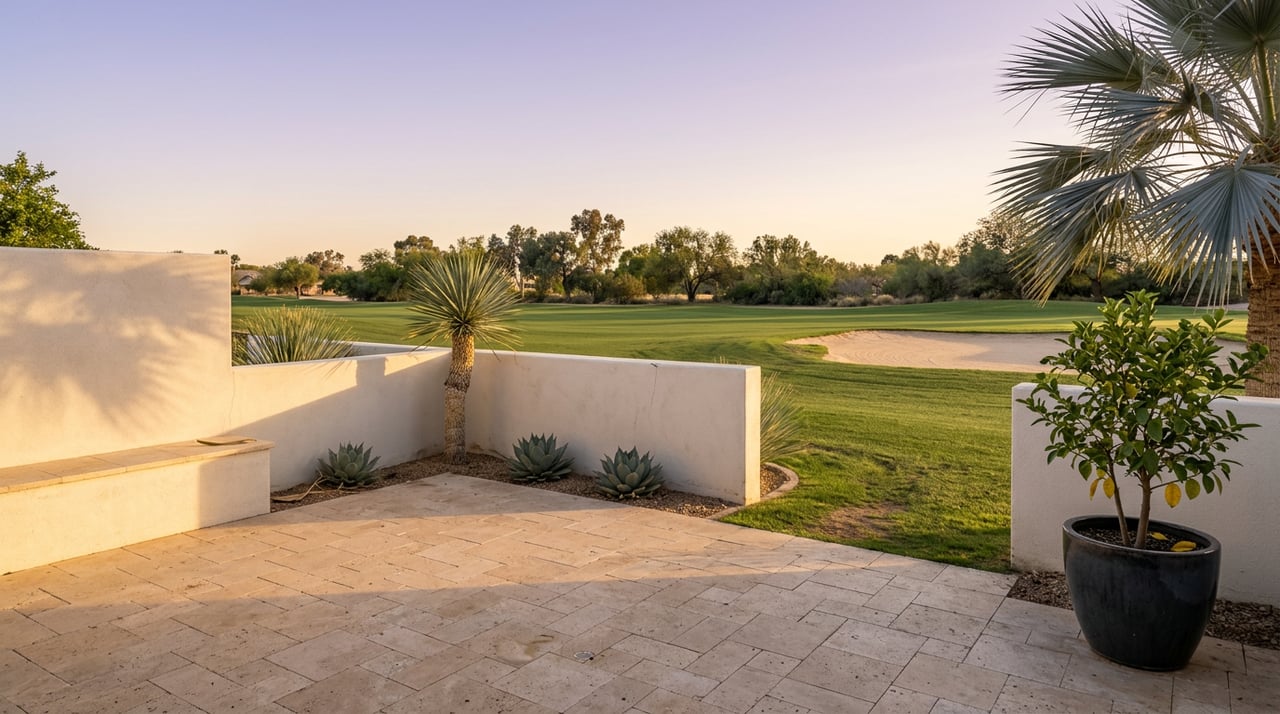
The Monday Night Ritual That Actually Runs Desert Falls Country Club
August 20, 2026
August 20, 2026
Walk into The Grill at Desert Falls Country Club on a Monday night once football season starts and you will not find golfers talking about their round. You will find couples splitting nachos at the bar, a table of four arguing about a coaching decision, and a server who already knows half the room's order before anyone opens a menu. Nobody at that bar just finished eighteen holes. Most of them did not play golf that day at all.
That is the detail that gets lost when people talk about Desert Falls. The conversation almost always starts and ends with the golf course, its ranking, its design pedigree, its one famous hole. All of that is real and worth knowing. But it is not what actually knits this community together week to week. The weekly glue runs through the clubhouse calendar and a membership tier that costs a fraction of what golf costs to join.
Any conversation about Desert Falls tends to open with the same résumé. The 18-hole course was built in 1984 by Ron Fream, a course designer known internationally for links-style work, and it plays as a 7,000-yard par 72 with Tifdwarf greens and five different tee placements on every hole. It has landed on the SCPGA's list of the desert's top ten courses and carries a four-star rating from Golf Digest's Best Places to Play program, a rating built around course condition, pace of play, staff, and overall value rather than prestige alone.
The course also has one piece of trivia that residents bring up more than any other. The par-3 14th hole carries a green measuring roughly 18,000 square feet, reportedly the largest green west of the Rocky Mountains. It is large enough that the pin placement effectively changes which of three separate sections of green you are putting on, depending on where the flag sits that day. Golfers who play Desert Falls regularly treat the 14th as a running joke and a genuine test in the same breath.
None of that is in dispute. It is also not the reason most residents describe Desert Falls as feeling like a real neighborhood instead of a subdivision that happens to share a gate.
Desert Falls runs on two separate membership tracks, and the gap between them is larger than most people expect. Golf membership carries an initiation fee in the neighborhood of $13,000 plus monthly dues around $800. That buys unlimited access to the course itself.
Then there is the social and fitness membership, which runs a small monthly fee, a fraction of what golf costs, and covers the fitness center, tennis courts, pickleball courts, and clubhouse access. Golf at Desert Falls has always operated on a pay-as-you-play basis alongside the membership option, which means the course does not require anyone to buy in at the $13,000 level just to spend an afternoon on it.
Here is the part that matters for daily life. Monday Night Football at The Grill does not require a golf membership. Neither does the Thanksgiving Day buffet, which by resident accounts is one of the best-attended events on the calendar each year. Neither do the seasonal happy hours or the couples' tournaments and mixers run through the Men's and Women's Golf Clubs, which welcome participation well beyond the strict golf-membership roster. The social membership tier is the actual entry point into the rhythm of the place. The golf membership is a separate, optional layer on top of it.
Strip away the course rankings and the club calendar looks less like a golf resort and more like a small town with a clubhouse instead of a diner. A few fixtures repeat often enough that residents plan around them without thinking twice:
None of this shows up in a course ranking. All of it shows up in the day-to-day texture of actually living inside the gates.
The instinct to lead with the golf course makes sense. It is the most measurable thing about Desert Falls, the part with a designer's name attached and a magazine rating to point to. But rankings describe a golf course. They do not describe a community.
What describes a community is whether a Monday night in October reliably has people in it, whether a holiday buffet is worth showing up for years in a row, and whether the entry point to that social life costs a golf membership's worth of money or something closer to a gym membership. At Desert Falls, the answer runs through the cheaper door. The 14th green is a great story to tell a guest. The Monday night crowd at The Grill is the actual reason people stay.
If you already live inside the gates, none of this is news exactly, it is just the part of the place that rarely gets written down. If you are weighing what daily life here actually feels like beyond the amenity list, that is worth knowing before the course ranking ever comes up.
For a closer look at how Desert Falls compares to other Palm Desert communities, the Desert Falls Country Club neighborhood guide breaks down the layout, the HOA structure, and what the surrounding Palm Desert area offers beyond the gates.
If you are further along and thinking about whether Desert Falls fits your next move rather than just your next Monday night, Andrew Shouse has spent years working this stretch of the Coachella Valley and can walk you through what ownership here actually looks like day to day. Schedule a free market consultation whenever you are ready to talk specifics.
Stay up to date on the latest real estate trends.