Coachella Valley Real Estate Reset: 2025–2026 Outlook
Market Update Andrew Shouse January 7, 2026
Market Update Andrew Shouse January 7, 2026
Final Year-in-Review Analysis for Buyers, Sellers, and Short-Term Rental Owners
As we close the books on 2025, one thing is clear: the Coachella Valley housing market didn’t crash — it normalized.
After years of pandemic-era volatility, December’s data from GPSR and CDAR confirms we’ve returned to something closer to a traditional, supply-and-demand–driven market. Prices are largely holding, inventory has rebuilt, and leverage now depends on strategy, not speed.
This update breaks down what the final 2025 numbers mean — specifically for buyers, sellers, and short-term rental (STR) property owners — and how each group should think about positioning in early 2026.
All data below reflects the most recent 90-day and year-end trends unless otherwise noted.
Source: Greater Palm Springs REALTORS® (GPSR) Desert Housing Report — December 2025
Median Detached Price: $660,000 (▼ 0.8% YoY)
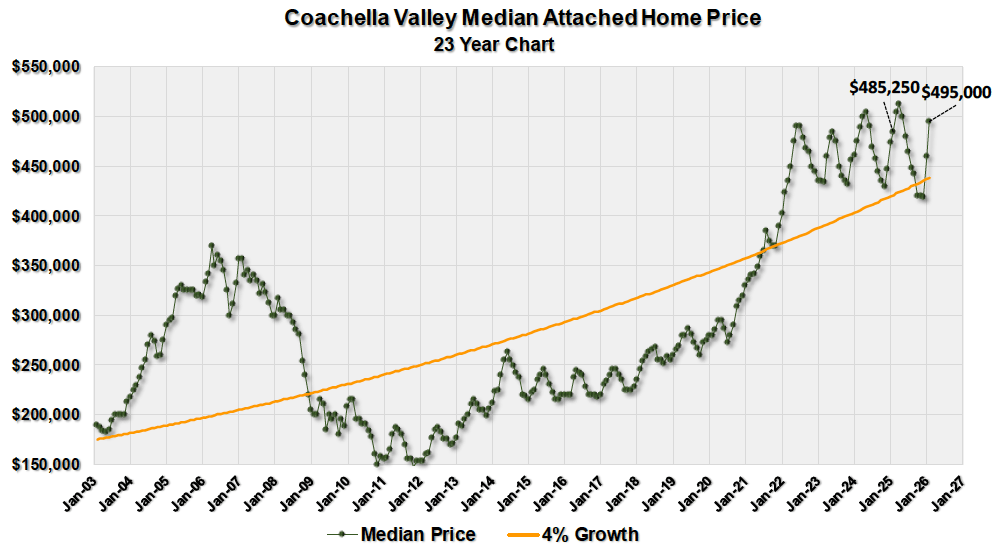
Median Attached Price: $460,000 (▼ 3.0% YoY)
Inventory: 3,028 homes (▲ 4.5% YoY)
Months of Supply: 4.9 months (balanced, slightly supply-heavy)
Median Days on Market: 47 days (▲ 6 days YoY)
Homes Selling Over List: 11.2% (back to pre-pandemic norms)
Average Sale-to-List Ratio: ~97%
📌 Translation: Prices are stable, inventory is healthier, and buyers have time again.
Sales volume recovered modestly but remains below historic norms
Pricing peaked earlier in the year and softened seasonally into Q4
Inventory is now comparable to pre-pandemic levels
Negotiation — not bidding wars — defines successful deals
This is not a distressed market. It’s a strategic market.
Top 3 Buyer Takeaways
Negotiation Power Is Back
With only 11.2% of homes selling over list and average discounts around 2–3%, buyers regained leverage across most price points .
More Choices, Less Pressure
Inventory is up Valley-wide, with particularly strong selection in Palm Desert, Palm Springs, and Rancho Mirage.
Timing Matters More Than Rates
Sales activity is steady, not frenzied. Buyers who focus on property quality and pricing discipline — not headlines — are winning deals.
📌 Buyer Strategy for Early 2026:
Target homes on market 30–60 days
Write offers with clean terms, not aggressive pricing
Use price bands strategically (e.g., $775k–$800k, not psychological pricing)
Top 3 Seller Takeaways
Correct Pricing = Faster Sales
Valley-wide median DOM is now 47 days, but cities like Indian Wells and La Quinta are closer to 40–41 dayswhen priced correctly .
Overpricing Is Penalized
Months of supply sits near 5.0 Valley-wide — but Rancho Mirage is closer to 6.9 months, meaning buyers there are choosier.
Condition + Presentation Drive Results
Homes that show well and launch at market-supported prices still sell close to list. Those that don’t… linger.
📌 Seller Strategy for Early 2026:
Price in $25k increments aligned with buyer search bands
Expect 2–3% negotiation in most submarkets
Front-load marketing and exposure in the first 21 days
Top 3 STR Owner Takeaways
Asset Values Have Stabilized
Despite softer pricing in some cities, 2025 confirmed that quality STR-capable homes held value — especially in Palm Springs, La Quinta, and Indian Wells .
Inventory Growth = Buyer Optionality
More resale inventory means future STR buyers are selective. Properties with proven income history, permits, and good layouts stand out.
Exit Timing Is Market-Specific
Indian Wells posted +35.6% YoY pricing on average-sized detached homes, while Palm Springs and Rancho Mirage corrected more meaningfully. One-size-fits-all strategy doesn’t work anymore.
📌 STR Strategy for 2026:
Re-evaluate pricing and revenue assumptions
Document operating performance cleanly
Treat resale as a financial asset, not a lifestyle sale
Source: CDAR Monthly Market Summaries — December 2025
La Quinta:
Inventory ▼ 25% YoY, MoS at 4.7, median price ▲ 5.6% YoY
Palm Desert:
Sales ▲ 28.8% YoY, median price ▼ 14.7% YoY, MoS steady at 5.1
Palm Springs:
Median price ▼ 17.0% YoY, MoS 7.4 (buyer-leaning)
Rancho Mirage:
Median price ▼ 14.3% YoY, DOM improving sharply
Indian Wells:
Median price ▲ 9.3% YoY, inventory ▼ 24.5%, luxury demand remains strong
The Coachella Valley market didn’t weaken in 2025 — it matured.
Buyers gained leverage.
Sellers must lead with pricing discipline.
STR owners should think like portfolio managers.
If you want help translating your specific situation into a smart 2026 move, that’s where real value gets created. Contact me!
Stay up to date on the latest real estate trends.
Weekly Newsletter
Weekly Newsletter
What Design, Photography, and Perception Tell Us About Long-Term Value
Market Update